

Solved

What does "other" mean in Experiments?

  • February 3, 2026
  • 4 replies
  • 35 views

Forum|alt.badge.img+5

So we’ve been running an experiment for about a week now, and discovered a row called “other”.


We’re guessing that it is counted as “other” when a user changes the product, say from Monthly subscription to Annual subscription in the device settings or app store. (*not* within the app or RevenueCat paywall)
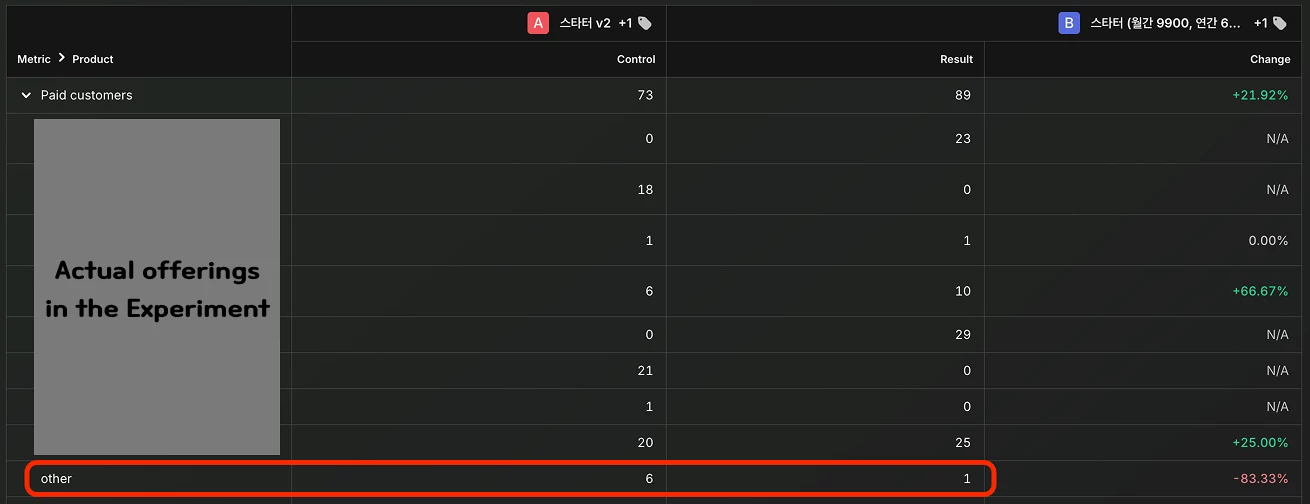
 

The question is, if our understanding is correct, how does this affect the actual offerings rows? 

For example, If a user changed from monthly subscription to annual subscription, then is monthly subscription counted -1 and annual subscription counted +1 in the Experiments report table? Or do the numbers not change once they’re counted?


Thanks!

Best answer by erik-macinnis

Hey,

No problem - glad the explanation helped!

It depends on whether the monthly subscription is included in either the Control or Treatment offering. If it is included, the purchase will be counted under that product. If it is not included, it will appear under other.

It’s also worth clarifying that once a customer is enrolled in an experiment, they remain enrolled until the experiment ends. After the experiment ends, the customer will begin receiving the default offering on their next paywall view.

Happy to clarify anything else if needed!

Cheers,
Erik

4 replies

erik-macinnis
RevenueCat Staff
Forum|alt.badge.img
  • RevenueCat Staff
  • February 3, 2026

Hi there,

I'm Erik, happy to help clear this up.

The other row appears when a customer who is enrolled in the experiment purchases a product that isn't included in any of the experiment's offerings.

How does this happen:

  1. Customers are enrolled in the experiment (assigned to a variant)
  2. Once enrolled, all their purchases are attributed to their variant
  3. If a customer later purchases a product outside the experiment’s offerings (for example, via App Store subscription settings or a special offering), the purchase will still be attributed to their assigned variant, but it will appear as other.

You can read more about the other category in our documentation: https://www.revenuecat.com/docs/tools/experiments-v1/experiments-results-v1#:~:text=customers%20enrolled%20in%20your%20experiment

Regarding how this affects your offerings rows:
The numbers don’t change once their counted. If a user purchases a product included in the experiment and later switches to a product outside the experiment, the original purchase count remains unchanged, and the new purchase is counted under other.

Let me know if you have any other questions!

Cheers,
Erik - Developer Support Engineer


Forum|alt.badge.img+5
  • Author
  • New Member
  • February 4, 2026

@erik-macinnis Hi Erik, I appreciate the detailed explanation. 


I have a follow-up question, just to see if I got things right.

So if a user purchases our annual subscription in the paywall within the app once being enrolled in the Experiments, and then changes their purchase to monthly subscription in their device settings or app store(i.e., outside the app), this will be counted as other, correct? I’d like to clarify my understanding.

Thanks!


erik-macinnis
RevenueCat Staff
Forum|alt.badge.img
  • RevenueCat Staff
  • Answer
  • February 4, 2026

Hey,

No problem - glad the explanation helped!

It depends on whether the monthly subscription is included in either the Control or Treatment offering. If it is included, the purchase will be counted under that product. If it is not included, it will appear under other.

It’s also worth clarifying that once a customer is enrolled in an experiment, they remain enrolled until the experiment ends. After the experiment ends, the customer will begin receiving the default offering on their next paywall view.

Happy to clarify anything else if needed!

Cheers,
Erik


Forum|alt.badge.img+5
  • Author
  • New Member
  • February 5, 2026

@erik-macinnis Thanks for the detailed reply, Erik! It helped a lot. :)